

Mark your Jewish recovery in Jewish time with Jewish Recovery Coins. We have coins for Jewish markers of time designed by a member of the Jewish Recovery Community.
To order, contact us or email intake@tikvahhealing.org.
Rosh Hashanah Coin
Sukkot Coin
If you or someone you care about needs help, please contact us!
Meaning behind the coin symbols:
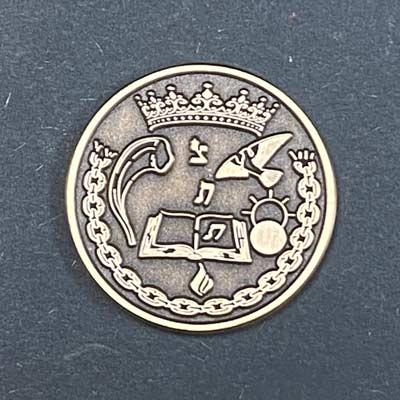
The Rosh Hashanah Coin
The theme of the Rosh Hashanah Token is teshuvah, which means "return" and is a central theme of the holiday. Teshuvah signifies a return not to what you were, but to what you can become. Similarly, in recovery, we aim not just to regain what we lost during addiction but to achieve our full potential.
Crown, Book, Shofar
A major theme of Rosh Hashanah and its prayers is Malchiyot, Zichronot, and Shofrot: Sovereignty, Remembrances, and the Sounding of the Shofar. The crown at the top symbolizes rising toward God's malchut (sovereignty), where we are cleansed and given a better chance, including the chance to help others. Recovery also allows us to rise from where we were and bring others along. As Isaac Luria explains in Sefer Hagilgulim (Book of Incarnations) 13:1, sometimes, souls descend into the depths of Kelipot (unholiness) due to a blemish. This blemish may cause challenges and troubles in that soul’s incarnations. But when a soul is elevated from Kelipot and enters Malchut for rectification, it can seize blemished souls before they descend. Once anyone begins to enter the side of holiness, they bring other souls along. The book represents Remembrances, signifying that recovery involves reviewing our past to rise above it, as outlined in steps 4, 8, and 9 of the Twelve Steps. The letters rising from the book are צ ,ת ,ת for Torah, Tefillah, and Tzedaka, the three keys to teshuva. The ת also stands for Tikvah, as in the Tikvah Center. The shofar serves as a wake-up call, urging us toward teshuvah. In recovery, we often have a moment of clarity that prompts us to seek help. This wake-up call, represented by the shofar extending from the bottom to the top of the token, carries us from rock bottom to the heights of recovery.
Broken Chain
The broken chain symbolizes freedom from addiction. In active addiction, our choices are controlled by the addiction itself. Recovery grants us the freedom to choose our paths. On a deeper level, the chains represent the entrapment of our holy essence. Rabbi Shneur Zalman of Liadi explains in Likkutei Amorim that "assur," typically meaning prohibited, literally means "bound up." When something is prohibited, its holy life force is bound in the unholy kelipot (husks). Through teshuvah, we can break these bonds and elevate both ourselves and the holy life force entangled in the kelipot. In recovery, our actions during active addiction often conflict with our inner morality, trapping us in misbehavior. Recovery allows us to break these bonds and use those moments as stepping stones toward our new selves.
Black and White Circles
In Chassidus and Kabbalah, holiness can be concealed in unholy kelipot. Prohibited items and activities are covered by a solid husk, while those that are permitted but not mitzvot are covered by a "translucent husk." Misused, the holy life force within these husks is concealed, but when used for good, it is elevated. The black circle represents the kelipot, and the white circle represents the holy life force escaping and becoming revealed holiness when our actions align with our values. In recovery, our actions can either mire us in misbehavior or elevate us to our full potential. Addiction traps us, like an impenetrable husk, but recovery reveals our true potential and holiness.
Bird
The bird symbolizes soaring freedom. The Grateful Dead song "Wharf Rat" is an anthem for sober fans. In it, August West reflects on his wasted life but resolves to "get back on my feet again someday, the good Lord willin’." At the song’s crescendo, he declares, "I'll get up and fly away." This powerful image is related to Rosh Hashanah, a holiday rich in symbolism. As we seek a fresh start for the new year, leaving addiction behind, we are like a bird soaring above our troubles.
Flame
At the bottom of the token is the flame, a potent symbol in Judaism. A flame always points upward, symbolizing our soul's constant striving for higher heights. On Rosh Hashanah, we acknowledge that our innermost essence is always reaching upward, and this is what we are recovering as we pursue our recovery.
The Sukkot Coin
The themes of the Sukkot Token are celebration, unity, joy, and revival. Sukkot marks the culmination of the Tishrei holiday season and is a time of ingathering. As an agricultural holiday, it involves gathering the produce of a long summer’s labor. As a personal-spiritual holiday, it involves gathering the fruits of one’s spiritual and emotional labor throughout the season of repentance and renewal, which begins in Elul, continues through Rosh Hashanah, and peaks with Yom Kippur. After this period of inner labor, Sukkot is a time to reflect and bask in its fruits, both personally and as a community.
Unlike the observances of the previous holidays, the primary observance of Sukkot, dwelling in a sukkah, is performed with one’s entire self. In fact, the obligation of dwelling or eating in a sukkah requires the majority of one’s body to be physically inside the sukkah. It is also relatively passive; there is nothing special to do or perform. The mitzvah is to simply go about one’s life within the sukkah walls. Sukkot is traditionally a time of communal rejoicing, marked by the tremendous joy of the Water Drawing ceremony in the Temple in Jerusalem. It is also a time for gathering with friends and family for meals and holiday celebrations in the sukkah.
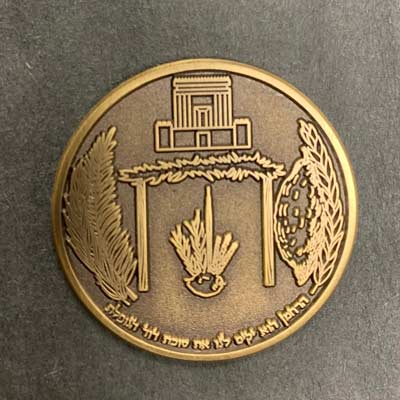
The Four Species
On the left side of the token is a palm frond overlaid with a willow branch. On the right side is an etrog overlaid with a myrtle branch. These comprise the four species of the lulav. One symbolism of these species is that they represent four types of individuals, all necessary to complete the Jewish People. Recovery is not a solitary endeavor. As one of the tenets of AA notes: “Our common welfare should come first; personal recovery depends upon A.A. unity.” Addiction is isolating; recovery is communal. Through recovery, we regain our place in the community of family, friends, neighbors, and colleagues lost to addiction. We reintegrate into the loving embrace of the community and bring our individual qualities and strengths found through recovery to enhance the community as a whole.
Sukkah, Circles, and Letters
The sukkah at the center of the token is both the symbol and namesake of the holiday. It represents a shelter containing the joy and unity of the celebration. The five circles symbolize unity. The center circle contains the three letters that make up the word sukkah in Hebrew: ה-כ-ס. These letters symbolize the three possible configurations of a kosher sukkah. The ס represents a sukkah of four sides. The כ represents a sukkah of three sides. The ה represents a sukkah of two full walls and a partial wall. All three configurations create a kosher sukkah. In recovery, we may feel broken beyond repair or that we must achieve a wholesale makeover of ourselves to leave addiction behind. However, our recovery can be like a sukkah. It may have four complete walls, forming a sturdy and enclosed space, but it doesn’t have to.
Three walls or even two walls and a partial one are no less kosher than a four-walled sukkah. Our recovery is not judged by some hypothetical wholeness. Instead, building an edifice of any type is sufficient and entirely acceptable as long as it provides shelter from the old troubles of our addiction. The four circles around the edge of the larger circle again represent the four species of the lulav and the four types of individuals that make up a community. They exist both within and outside of the larger circle. In recovery, we find safety and joy in our connection with the community while maintaining our paths and building ourselves as individuals. All five circles and the letters shine with the light that comes from unity, community, and celebration.
Inscription
The inscription at the base of the token reads: “הנופלת דוד סוכת את לנו יקים הוא הרחמן” “May the Merciful One restore for us the fallen sukkah of David.” This verse is recited in the blessing after a meal throughout the holiday of Sukkot. It is based on a verse in Amos (9:11): “In that day, I will set up again the fallen sukkah of David: I will mend its breaches and set up its ruins anew. I will build it firm as in the days of old.” This refers to the final Messianic age in which the dynasty of the House of David will be restored.
The sages ask why the House of David is referred to as a sukkah and not a more sturdy and stable edifice. One answer is that a palace or other permanent structure, once destroyed, can never truly be rebuilt. Whatever is built in place of the destroyed building is a new building. A sukkah, however, can be deconstructed and reconstructed repeatedly, yet it remains the same sukkah. In recovery, it can feel like we have lost whatever life we had built before our addiction. But our lives are not like a building that, once destroyed, can never be reestablished. Instead, our lives are like a sukkah that can lay in pieces throughout the year (or for many years) only to be rebuilt once again when the time is right.
The Temple
The Holy Temple at the top of the token is a reference to the verse about the sukkah of David. Although David did not build the Temple (his son Solomon accomplished that task), it is still symbolic of his dynasty. Currently, the Temple is in ruins; only the Western Wall remains. But for thousands of years, Jewish people have dreamed of the day it will be rebuilt. This hope of rebuilding the spiritual center of Jewish practice hovers over the other symbols of Sukkot. In recovery, hope and revival are critical as the overarching impetus to leave addiction and build a better life. While our lives may be complicated, difficult, and not always perfect, hope and revival hover over all that we do. The image of our own rebuilt spiritual center, always present, provides a driving focus to lead us from addiction to recovery